[Background: After the crash/fall on 4/13, with additional reflection by Lani on 4/14, we're becoming a road trip until we get to Washington state. Today, I am to take the Greyhound back to El Paso and return in a rented car that we can drive, one-way to the Northwest.]
Up, oatmeal cooked on the butane in the motel bathroom (note to self: look for microwave-safe cook wear), packed and walking to the alleged Greyhound stop at a Chevron about 1.3 miles away (there’s no taxi service in Deming) I was anxious about what the day held.
Armed with the information provided by Greyhound's automated phone service, I moved briskly down Deming's main road in the cool morning sun towards the Greyhound station at a alleged Chevron station. In transit, just to confirm, I called several times the local Greyhound number; no one answered. Wielding my iPhone and summoning the Google, I located the Chevron number at the same address as the alleged Greyhound and called. I was informed that the automated Greyhound number had given me the wrong address for the bus stop. Hey...Greyhound, was this a joke?...how many others had been similarly deceived? The nice lady at the Chevron station gave me the correct address. I diverted.
The 9:30am pick-up was only off by 4 hours, delayed by an overturned semi on I-10. So, instead of being back in Deming by 2pm and leaving for Phoenix that day, I was now looking at another night in Deming. Marvelous.
The bus ride itself to the Greyhound terminal in Deming was unremarkable. And, after a taxi ride, I found myself at the same car rental area at the El Paso airport I had used just 5 days ago.
Before you buy your next steak or package of ground meat, you might want to read up on factory farming. Existing only because of government farm subsidies, it features animals in close quarters and heavy antibiotic use.
The U.S. Government passes a farm bill at 5-year intervals that subsidize industrial farming, distorting our diet and affecting our health. Cheap corn produced here has a negative effect on emerging, 3rd World economies, contributing to poverty.
Your ability to supersize your Whopper comes at the expense of impoverished farmers in emerging economies. It also means that your fast food, as well as anything where the ingredients label say "partially hydrogenated soybean oil" is tax-subsidized.
So, another day, was pretty much wasted.
On the other hand, it gave us another chance to look for some authentic New Mexico cuisine, which we found at Campos Restaurant in Deming. I had a great chimichanga (essentially a deep-fried burrito, the origin of which is steeped in Mexican food lore) with green chile. (Green chiles are those that are picked unripe; they are fire-roasted, then peeled before further use.) Yum.
Tomorrow: the road trip begins...to Phoenix...and beyond.
It sounds quiet outside, but a quick check of www.wunderground.com indicated 14mph headwinds, getting worse throughout the day. Following yesterday's debacle, Lani remained resolute on the current plan: a circuitous road trip to Washington state, then bike East. We'd being in Deming at least long enough for me to procure a rental car that we could drive, one-way to Seattle, or thereabouts. But, for now, we needed something locally...in Deming.
Speaking of Deming (population=14116), it was founded 1881 and, like every other town we've seen since entering Texas, Deming owes its existence to the railroad and the completion of the Second Transcontinental Railroad, named after Mary Ann Deming Crocker, wife of Charles Crocker, one of The Big Four of the railroad industry. The Silver Spike was driven here in 1881 to commemorate the meeting of the Southern Pacific with the Atchison, Topeka & Santa Fe railroads. Nothing like Big Business in Local Politics.
Deming has a single car rental location at the airport. Bob, from Desert Car Rental picked me up. I drove off with the only one of his 8 cars, a Ford Focus; $45 for the day with 100 free miles. Lani and I took off for nearby parts unknown.
We stopped first at the City of Rock, a New Mexico state park. The park encouraged RVs and tent camping and, for only $5, you had some pretty modern facilities. We went for a walk.
I love a good cactus garden.
Given space to garden, I go for fruit-bearing trees, preferably sub-tropicals and citrus. If I only have a few square yards, I plant tomatoes, herbs and spices. If I have to plant something inedible, it's either roses or cacti. The park had a small cactus garden with some of the cacti flowering.
This is, clearly, an example of the Kingcup Cactus, featuring large flowers and edible fruit. Yum.
The Chihuahuan Desert has been poorly studied, but may be the most biologically diverse desert in the world, whether measured on species richness, although the region has been heavily degraded over time.
Lani and I went for a walk around the park.
Lani left the cactus garden and stepped into theCity of Rocks.
When Susan and I bought our first Santa Monica home in 1985, the garden areas in the backyard and all around the fence perimeter were planted with a species of Agave that had a wicked serrated edge and a steely-hard spike at each tip.
The heart of the Blue Agaveis removed when it is 12 years old, fermented and then distilled to produce one of the most repellant liquors known to humankind, Tequila.
Do they serrated edges and spiked tip look sharp? In reality, they are way sharper than they look...killer sharp.
I can't tell you how many times I'd be gardening in our backyard, trying to clear out the grass that would grow underneath and I would hear the agave whisper "gotcha" as it drew blood. I tolerated them until Lani was born and then ripped them all out for safety reasons.
Pottery, arrowheads, and other artifacts show evidence of prehistoric Indians in the area. Indian wells, or conical holes, are found in the rocks where water would be allowed to collect.
The park provides opportunities for walks, hiking, camping, picnicking, wildlife viewing, and dark night-sky viewing (including a 14-inch telescope).
If you pitched a tent, you were far enough from anyone to feel quite alone. The camp facilities included a shared shower. A great deal for $5.
There were many interesting rock formations.
I'm sure we are the only people to have ever done this. Lani pulled a similar stunt with a much more convincing outcome here.
Almost done with the rocks.
Lani and her dad.
The City of Rocks is appropriately named.
Panorama stiched from 3 images. If you want a 12' wide poster, let me know.
Having seen enough rocks, we took a drive to Silver City, population=10545,once an Apache Campsite and an area that was overrun by American prospectors in the 1860s, becoming a full-fledged city in 1870 after the discovery of silver. Mining (in copper) is still the basis for the local economy, followed by tourism, retirement and trade. Why Silver City? Well, while we were biking on I-10, there were several large billboards imploring me to visit.
Approaching Silver City, there was the usual dusty Western sprawl of increasing congestion approaching the most interesting part of the city, the part near the University. Once there, we parked and walked…and endless array of art galleries and coffee shops.
We looked for a suitable establishment for lunch, preferably something representative of the New Mexico cuisine featuring green chiles that I'd recently heard of. We stumbled into the Jalisco Cafe, which turned out to be a great call. We hadn't known it was mentioned in the seminal article 36 Hours in Silver City, N.M. in the NY Times.
The chips and salsa were excellent but the green chile...a new taste sensation for us. In fact, pretty much every menu item was slathered in either green or red chile. The menu warns you to know what you're ordering before its served. It was a memorable meal.
We walked around the shops on Bullard Street, a home to many quaint stores.
Lani is attracted to stores that involve crafts. Clever name.
Lani was then sucked into this book store which featured a large selection of old and used books.
Books...lots of old books...lordy, this is boring. Where can Bob go to have a cup of coffee and a good chocolate chip cookie?
Coffee shops were everywhere and the Javalina Coffee House was nearby.
Coffee, a chocolate chip cookie, WiFi and Bob is good. The atmosphere was, obviously, informal and the crowd local.
Returning late in the afternoon, Lani confirmed that a new phase of our trip would commence and continue until we reached Washington State. The problem: how to get a car with a one-way rental. In case you’re wondering, the answer lies in renting from a major car rental center, like a major airport. The nearest one was El Paso, Texas, 100 miles back East. (Didn't I already rent a car from the El Paso airport?) So, I’m on a Greyhound tomorrow morning and,if nothing goes wrong like last time, I’ll be back by early afternoon. Lani has a friend in Phoenix and had already arranged for some critical bike parts to be shipped there. We’re planning on camping at a park about an hour outside Phoenix.
You can see our route from Las Cruces, NM to Deming, NM HERE.
Windows open overnight, the temperature quickly dropped in our KOA cabin to the 50s…great for sleeping.
50°F? Of course I'm fully dressed...it's as cold in here as it was outside. Otherwise, it's oatmeal as usual on the butane.
We stepped out our KOA cabin into the brisk air with the dawn just beyond the Mesilla Valley mountains.
I love sunrises and sunsets (who doesn't?), but photographing them is a challenge because the luminance dynamic range is so extreme. I usually carry a 4x graduated neutral density filter, but left mine at home. Without the filter, you have to chose between properly exposing the sky or the foreground. Here, the sky dominates at the expense of detail in the foreground. Oh well.
Leaving the campground, we faced a short, steep climb out of the Mesilla Valley to I-10. This was going to be our first segment on an interstate.
Lani had called the New Mexico Department of Transportation and confirmed that biking on the interstate was legal in remote areas where there was no other option.
Having lived in Santa Monica, CA for 14 years where I-10 is known as the Santa Monica Freeway, I-10 has a special place in my heart. I also know I-10 where it meets the Atlantic Coast in Florida. I was sorta excited to hop on in the middle of the country.
The 54 miles from Las Cruces to Deming would be along the I-10 shoulder. In spite of the traffic zipping by at 70+ miles per hour, I felt pretty safe; the shoulder was wide and most of the vehicles shifted to the inside lane as they passed us. The quality of the shoulder, unfortunately, sucked and slowed us down. What was really cool was when a big rig passed us at high speed right along the shoulder and you could draft.
Even though the adjacent traffic was zipping along the wide shoulder gave us a nice safety margin. Unfortunately, the quality of the shoulder sucked. Drafting in the slipstream of passing trucks helped.
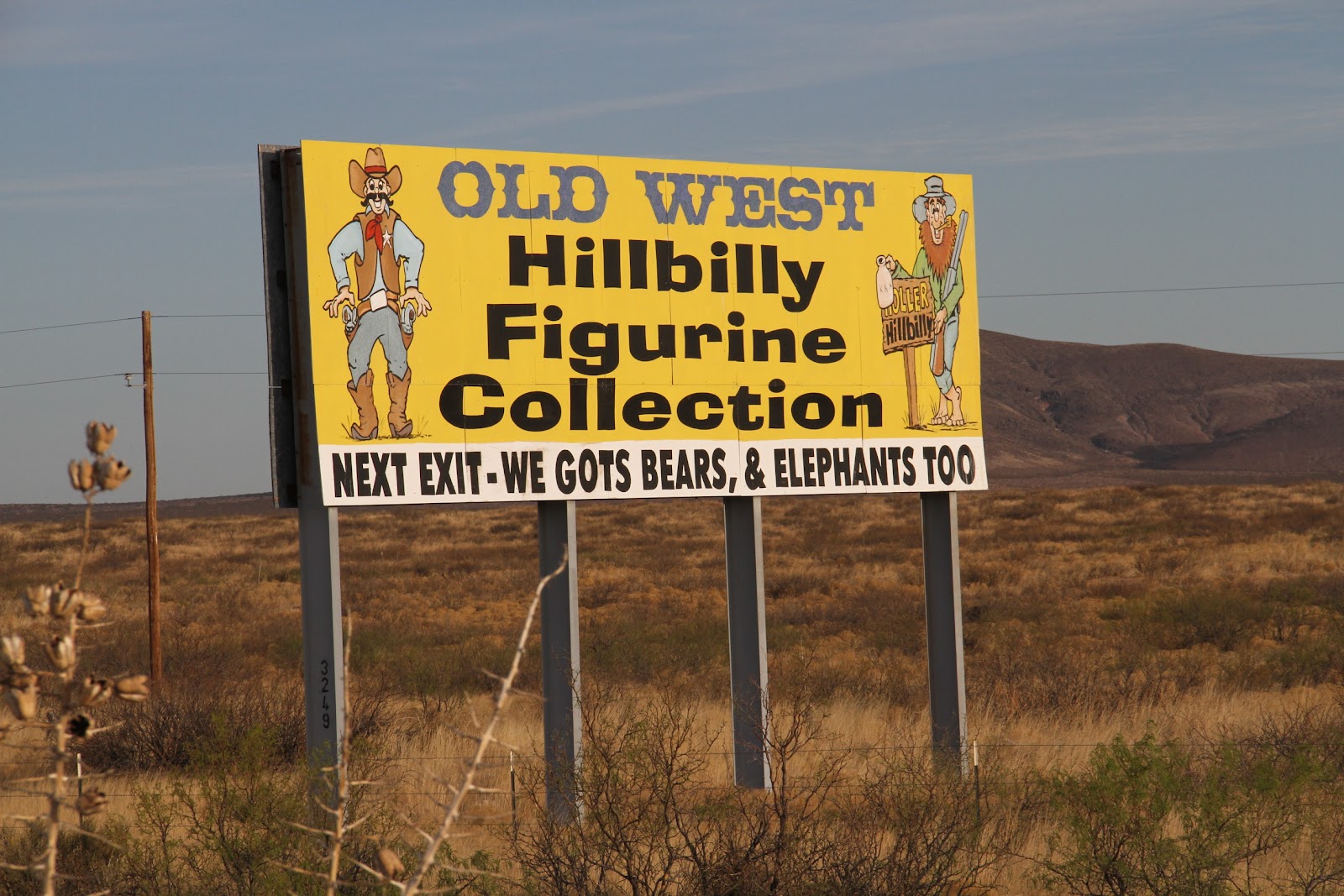
Exits on this segment of I-10 were far and few, but they would announce themselves with a marketing vengeance.
Hillbilly figurines? Are you joking me? And you "gots bears, & elephants too", as well as the inability to punctuate? Was I missing a hot collectible? If it does not have its own Wikipedia entry, you know it's esoteric.
The marketing onslaught intensified as the exit neared.
In many areas, there was a feeder road paralleling the interstate. They were often in a great shape, turn to gravel, or disappear at which point you'd have to return to the interstate. So, we just stayed on the interstate.
Biking through the miles of nowhere I would often think "this would be a great place for a maximum security prison." The state of New Mexico thought likewise.
There were these guys in orange jump suits trying to hitch a ride and I was going to stop and let one sit on each of my panniers..good thing I saw this sign.
The winds were light and even though the shoulder was in poor shape, it should have been a completely uneventful 54 miles to Deming. Should have.
I had been biking behind Lani for nearly 1600 miles and had observed that she biked with her head down, like she was fixated on a spot just feet in front of her. I'd occasionally shout out "Hey...look around...check out the scenery." That would last for a few seconds, then she'd look down again.
We approached a Border InspectionStation with some construction along the way. During the approach, large barrels were situated in our path to mark some construction. Lani, biking with her head down, did not appear to see them; I called out to her “Heads up!” She said “thanks” and we biked around them until we took our place in the traffic line at the inspection station. No big deal. We were waved through the inspection station.
Leaving the inspection station, we returned to the shoulder where more of the orange barrels were situated in our path. Lani deliberately moved right and biked around the first few and then, head down, she aimed dead on into a barrel. She collided with the barrel and went down pretty hard. I barely avoided her before I went down, but not as hard. Her left arm was bloodied and she was shaken. My flag pole snapped.
The collision re-set the tone for the day.
I can't recall the last time I really raised my voice at Lani, let alone swear at her...maybe never (I'm not much of a swearer), but this could have been horrendous and it was totally stupid and avoidable.
Eventually, we got back on our bikes, but this set the tone for the rest of the day. The winds worsened and Lani’s progress (and, therefore, mine) dropped to a relative crawl. To make matters even worse, she had another near mishap where the shoulder meets the dirt…we had our first all-out shouting match with each other as tempers flared.
I apologized to Lani for shouting at her (as well as for the profanity) and we returned to our usual daughter-father relationship. I took a look at her arm.
It could have been a lot worse. This is why I always travel with Ibuprofen in the industrially-sized 800mg size.
I never appreciated how the railroads were such a part of the Southern corridor. Watching the parallel rails meet at infinite, I thought of the summer job my Mom had landed me in 1975, taking apart railroad track with a long crowbar, pulling out the spikes. I made $5/hr, netting $161 and change for the week.
The passing loops on each track allows for one train to "park" and another to pass.
Finally arriving in Deming, picking up some fresh produce at the Walmart and sandwiches at Subway, we reverted to normal in the motel room. The windy conditions had clearly changed the experience for Lani and what was once fun was no longer…she was prepared to change the nature of this portion of our sojourn from a bike trip to a road trip, resuming the biking from Washington State.
I’m not sure how I feel about that…actually, I do…I’m disinclined. It changes the nature of my self-proclaimed unequivocal experience, it makes the title Doctor Bob’s Bike Blog inaccurate and it feels a bit like cheating. Actually, a lot like cheating.
And, what about the exercise? I needed the exercise...badly. I had been counting on the 6-8 hours of daily biking to help me with the sucky weight gain that had accompanied the past year of androgen deprivation therapy. What now?
Anyway...
I had proposed a day off, renting a car to head to Silver City and the cliff dwellings as the wind forecast for tomorrow were even worse than today…
You can see our route from El Paso to the KOA campground in Las Cruces, NM HERE.
I guess I should say something about El Paso, this west Texas city of 800,000, stumbled upon by the Spanish in 1598 and really taking off after the Civil War, continuing to grow even now because of cross-border trade with Mexico...I should, but I'll limit it to how I knew of El Paso at the age of 6 because of the chart-topping hit by Marty Robbins, El Paso, that my mom played over and over and over on the record player in the basement as she worked on her ceramics.
Anyway...
Up at 4:45am after sleeping poorly…I think it was the low battery chirp of the smoke detector that kept awakening me at 60 second intervals. Oatmeal, CNN, then out-the-door and on the road at 6am. With the change to Mountain Time Zone, the sky was already light. And, with El Paso being the biggest city we’ve been in for hundreds of miles, the major roads were already buzzing. It didn't take very much biking to tell that we were no longer in the Texas desert along US90.
Did you know that wine making dates to the 1800s in the El Paso region of Texas? I didn't, either. Zin Valle Vineyards produces a full menu of wines.
Zin Valle vineyards dates to 2000. While the climate may be suitable, there were some soils issues as the new owners brought in 100 tons of sandy soil to create planting rows of 3' deep.
The road we were on passed in and out of Texas and New Mexico but, after the winery, we remained in New Mexico. Unfortunately, we took off on some small errant rural road and missed the Tex-New Mex border crossing sign.
But: what great landscape! If any scenic feature defined the landscape upon entering New Mexico, it was the pecan orchards: neatly aligned rows of bare trees covering acres of land, often flooded.
Pecans are not native to New Mexico and were first planted in the early 1900s. New Mexico now has about 30,000 acres of pecan trees that produced about 50 million pounds of nuts in 1999. New Mexico State University's agricultural section has a department devoted to the industry.
The pecan farms were reminiscent of the large cattle ranches in Texas, but clearly with a different feel: a small managed forest versus acres of grass and cattle. I preferred the pecan trees.
Pecan farms are available for purchase at a pretty reasonable price. (You should click on this picture. You should.)
I lingered in this area, rather captivated by the trees reflecting in the water. This is one of my favorite photos...you should click on it, too. You won't regret it.
There were long stretches of highway, flanked by pecan orchards, where the cars would disappear long enough for it to become nearly silent.
Not quite as pretty as the pecan farms were the fields of picked cotton.
Cotton farming is an important issue in New Mexico as it touches on free trade as well as subsidies.
We enteredLa Mesa, New Mexico, a 4-block square "town" where we stopped for a rest.
So, it turns out that right across the street from this gas station is the famed Chope's, a restaurant famous for its green chile dishes.
I had been alerted by a friend about the cuisine in this part of New Mexico, especially the famed green chile dishes...but we missed out on it in this area! The New Mexico chile, especially when harvested as green chile, is perhaps the defining ingredient of New Mexican food compared to neighboring styles. Chile is New Mexico's largest agricultural crop. Chope's, it turns out, is legendary, with lunch crowds exceeding that of the local population. Next time. ;(
We biked on, entering nearby La Mesa, New Mexico. There was a church and not much else.
The San Miguel Catholic Church, a common church name in this area, dates to 1927.
The day was spent passing through mile after mile of pecan orchard...it was definitely one of the most scenic parts of the trip so far. There is something I find special when the land becomes part of the livelihood of the people who live there.
I saw someone picking their nuts; it was pretty rude...I mean, it was just plain gross.
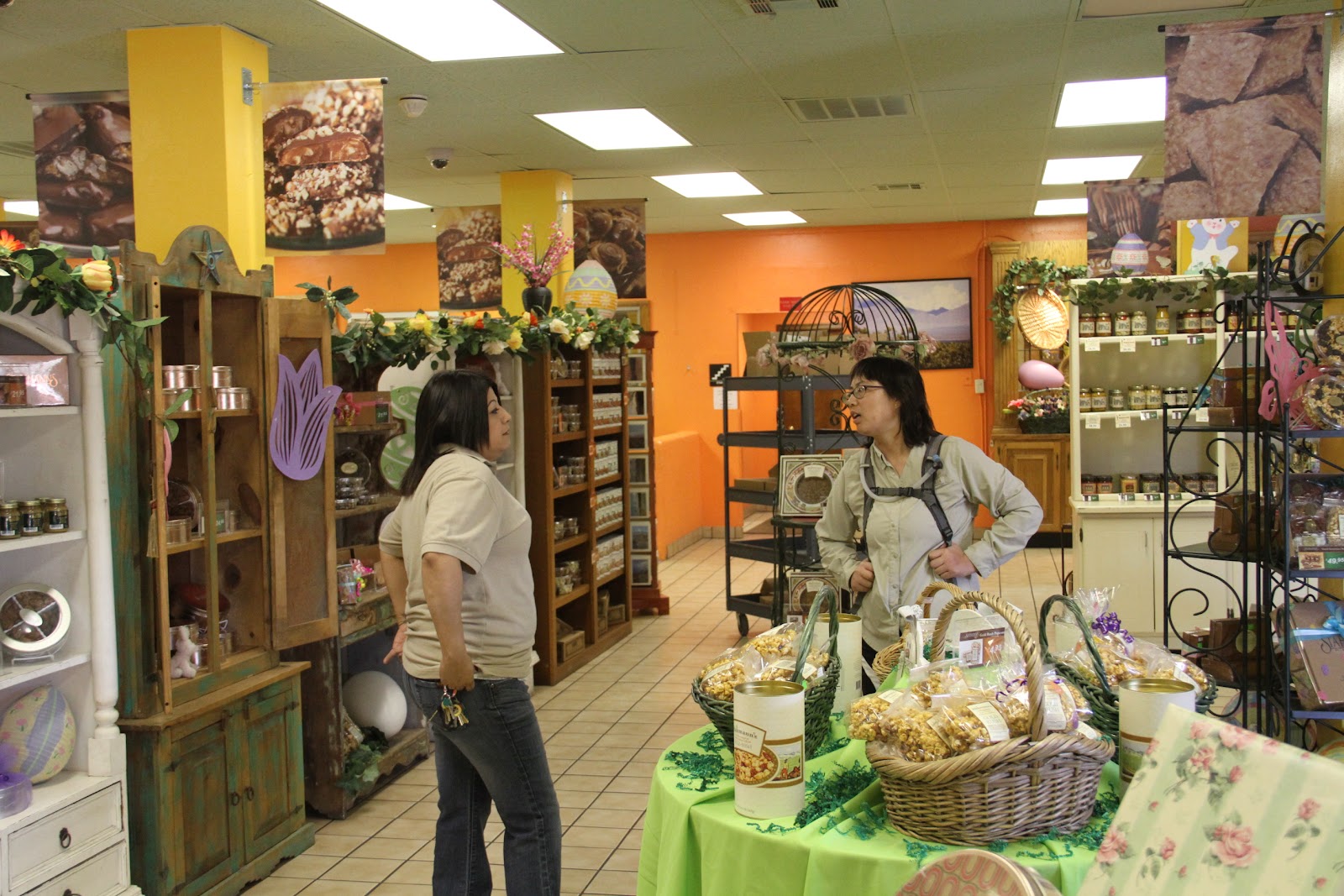
With signs alerting you for miles in advance, you eventually come across Stahmanns Country Store, surrounded by their own pecan farms. W.J. Stahmann came to the Mesilla Valley of New Mexico from Wisconsin, on a barge traveling down the Mississippi, keeping bees along the way, purchasing the first 2,900 acres of what was to become Stahmann Farms. He and his son Deane cleared the land with teams of mules and planted acres of cotton. Seventy years later, in a prescient move, Deane Stahmann decided to pull out his cotton plants and plant the first pecan trees in the valley, 4,000 acres in total.
Lani discusses pecans with one of the store workers.
After planting another 2000 acres of pecans in Australia, Stahmann became the largest pecan growers worldwide. Regardless, it turns out that Bob really doesn't care for pecans.
With all these pecan trees, I figured there would have to be pecan blossom honey. Was not the case.
Moving along, we passed a home with a giant woodcarving by Richard Gonzales, a sculpture and woodcarver with a strong local reputation in the Las Cruces area of New Mexico. I spent a good 30 minutes trying to find additional information on Mr. Gonzales on-line, turning up just enough to confirm that he had done some wood sculptures locally. Finally conceding that the Internet-Google tubes had failed, I called the phone number on the plaque at the bottom of the carving that was visible on the photograph.
The area code had changed, but the remainder of the phone number was correct, enabling me to contact Mr. Gonzales.
The reason why the Google had failed to turn up any useful information on Mr. Gonzales was simple: he does not have a computer, email address, nor web site. Fortunately, he did answer his phone and was happy to talk with me. The wood carving above was done in 1993 and sits on the property of the person who bought it. Mr. Gonzales has been a life-long native of Mesila, NM (population=2180, an area dating to 1848 that was founded by a group of people who whose butts were chafed when the Treaty of Guadalupe Hidalgo moved the U.S.-Mexico border south, thereby making them Americans. Mesila became again, a few years later, part of the U.S.)
The large carving on the left was done by Mesila native Richard Gonzales in 1993.
Mr. Gonzales has been carving tree stumps since 1992, often with stumps that are brought to him from the owner of the land where the tree had died. He noted that there were not many trees in the area, but the recent harsh winters had lead to an epidemic of tree death and many stumps to carve. He moves from project to project, commissioned by what has been an endless series of clients who seek out Mr. Gonzales by word of mouth.
Finally, after about 40 miles of an incredibly scenic stretch of New Mexico (something neither of us had anticipated!) we pulled intoLas Cruces. With a population of nearly 100,000, Las Cruces is the economic and geographic center of the fertile Mesilla Valley, which is the agricultural region on the flood plain of the Rio Grande.
The biking conditions were generally excellent: flat and favorable winds until the final half-mile climb to the KOA campground. We took a cabin at the campground and relaxed the rest of the day, taking advantage of the WiFi to plan, read news and blog. We bought a can of chili from the KOA store to add to our lentils and quinoa…yum.
KOA campgrounds seem pretty consistent. Nice facilities (common showers, pools, playground for children) with plenty of spots for RVs and campers, there are usually a few cabins.
The KOA cabins are about $60, a little more than twice what it would cost to pitch a tent. Besides being more comfortable overall, they provide a time saving. Still, for that price, I can usually find a cheap motel and avoid having to deal with the shared bathroom/shower.)
Lani, looking in
This cabin is virtually identical to the cabin we had in Perry, FL, from the layout to the bunks. Spartan.
Lani gets a little laptop time in.
It was a great day...we entered New Mexico and bike in rural pecan-flanked splendor for about 40 miles. I know the image of the orchards will stay with me a long time.
Oatmeal eaten, panniers re-packed and bikes loaded into the Kia, we took off around 8:30am for El Paso, about 220 miles.
It would be nice if car rental companies offered a bike rack. Stuffing a pair of bikes into the back of a van pretty much sucks up all the space.
As sleazy as most of these motels looked, many of them completely filled up at night. (Who would stay there during the day?)
That's our car on the left with the open back. Because of the Amtrak fire, we spent way more time here than anticipated.
Actually, by the time we checked out of the comely Motel Bien Venido, after spending 26 hours on the halted Amtrak, my head was ready to explode and the signs outside of the motel were just yanking my chain. Maybe I'd be a little more tolerant if Lani had not awaken yesterday covered with flea bites.
You're kidding me...right? Fleas...are they reasonable?
Just one more...then it's out of my system.
The WiFi sucked, there was no "micro fridge", unless it was too microscopic to see and there was no kitchenette. Did I tell you I had just spent 26 hours on the Amtrak for what should have been a 3-hour ride?
We finally got on our way. As guilty as I felt about not biking this long Texas stretch, traversing it a 3rd time in two days did pretty much reinforce that it was worth skipping. From US90, there was little to see in Marfa, but...
You certainly have to admire the truth in adverrtising, but it turns out that El Cheapo is a successful chain of liquor stores, complete with a web site and its own line of t-shirts and refrigerator magnets.
It turns out that there was more to Marfa than met the eye from US90. Population 2121, as with all of these towns along US90, Marfa owes its history to the railroad, beginning in 1880 as a railroad water stop. Today, Marfa is a tourist destination for its architecture and art, as well as for the Marfan Lights. First described in 1957, they lights have been described asglowing basketball-sized spheres floating above the ground, or sometimes high in the air.They were studied by a group of physics students in 2004, concluding that they were traffic lights on US Highway 67 reflecting off of the atmosphere Regardless, the town of Marfa built a viewing platform and holds an annual Marfa Lights Festival.
While we didn't take in the Marfa highlights, nor stick around at night to see the lights, we did see the results of the brush fire that halted the Amtrak I had been on the other day.
There were acres of charred grass along side the highway.
The fire had even jumped the highway.
With this house destroyed, it was no surprise that the train bridge had also been damaged.
When the train finally started rolling yesterday in the morning light, I saw a strange blimp-like object in the distance. On the road, I was able to get a better look
The Tethered Aerostat Radar System is a balloon-borne radar system whose primary mission is to provide low level radar surveillance data in support of the nation's drug interdiction program. Its secondary mission is to provide North American Aerospace Defense Command with low level surveillance coverage for air sovereignty in the Florida Straights.
The Tethered Aerostat Radar System handles low altitude surveillance along the Texas-Mexico border as well as monitoring air space between Florida and Cuba. Tethered by a single cable, it can rise as high as 15000', but usually operates at around 12000'.
Unless you've driven this stretch of US90 - or a comparable strip of barren highway (and we've biked on a bunch of them) it may be difficult to appreciate how much nothing there can exist between small towns (in this case, Marfa, population=2121 and Valentine, population=187). So, imagine our surprise at coming across a Prada shop.
Prada? Seriously? Here? This called for a double-take and a panorama to show just how isolated this was.
So, it turns out that Prada Marfais a permanently installed sculpture by artists Elmgreen and Dragset, located 1.4 miles northwest of Valentine, Texas, just off U.S. Route 90, and about 37 miles northwest of the city of Marfa. The project cost $80,000 and was intended to never be repaired, though this plan was deviated from when, three days after the sculpture was completed, vandals painted "Dumb" and other graffiti on the exterior, and broke into the building stealing handbags and shoes.
Pretty crazy, huh? It looks really cool at night. It pretty much is in the middle of nowhere, a place where Lani and I seemed to find ourselves often.
We finally escaped US90 and made it to I-10, allowing us to travel the Western Texas wilderness as fast as 75mph. I-10 was 100 miles of desert, though we did pass – along the frontage road – Paul, a biker from San Francisco whom we met back in Marathon. He was grinding on through the West Texas void. (Sadly, I never took his picture.) Arriving in El Paso, we were immediately impressed by its sophistication.
Somewhere, a cabal of puerile marketing consultants is hard at work. Is that tongue really necessary?
Bicycle chains stretch out over time. I had mine replaced in San Marcos, TX after only 1000 miles. Lani, on the other hand, had several thousand miles on her chain without it being replaced. When a chain stretches, it can start to reshape the teeth on the cassette, which can lead to additional repairs. So, we looked for a bike shop for Lani.
Duncan confirmed that Lani’s chain was well stretched beyond the usual limits and changed it out, along with the rear cassette.
Back in our room, Lani found out that she had picked up another slow tire leak.
Lani was pretty adept at fixing flats. I delegated all bike repairs to her.
The day ended on a very, very high note: Lani logged on to her email and found out that she had been accepted to a second graduate school, Boston University BU has a great program and Lani was excited…we both were…and went out to dinner to celebrate. Good times.
Tomorrow, after 4 non-biking days, we [finally] hit the road again.